
SEE THE DOG: Observation Skills
Take your observation skills to new levels with this exciting course from Suzanne Clothier.
New session is tentatively scheduled for Fall 2026
You've been watching dogs for years. You think you're good at it. But what if the problem isn't what you know — it's what you're not seeing?
Scientists have proven that humans can stare directly at something and completely fail to see it. If that can happen to trained researchers in a controlled study — eyes open, fully focused — imagine what's happening when you're working with a dog under real-world conditions, when emotion is running high and things are moving fast.
And when we do notice something, we reach for a label. We call a dog "reactive" or "stubborn" or "anxious" — and we think we've said something meaningful. But labels aren't observations. They're where observation stops. They close the door right when curiosity should be opening it.
The cost is real. An inaccurate observation doesn't just mean you misread the moment. It means everything that follows — your training plan, your assessment, your response — is built on a foundation that isn't real. For professionals, it can mean failed training and dangerous situations. For dog owners, it means missing the signals your dog has been sending you all along.
This course doesn't teach you a list of things to look for. It trains your brain to override its natural limitations and see what's actually there.
"You will observe everything differently."
That's what students tell us, again and again — not just how they watch dogs and other animals, but how they move through the world with fresh eyes and new perspectives.
There is no minimum experience level. What every student shares is a genuine desire to see more clearly.
Imagine seeing the stress signals before your dog bites, or recognizing the learning moments that happen dozens of times each day. Respond to what's actually happening.
Without right observation, we cannot make correct assessments. Sharpen your ability to identify patterns, solve problems quickly, and help clients more effectively.
Develop precise, descriptive observation skills that go beyond subjective labels — especially critical when assessing animals in high-stress environments.
See more, miss less, and make better decisions for the animals in your care. Training, health care, welfare, and placement in the right home - all depend on observation.
Train your eye for meaningful behavioral differences. Systematic observation changes what you see and what decisions you make for each dog.
Learn Suzanne's practical approach that is grounded in clear language and concepts that help your clients develop their own observation skills.
This course doesn't start with a list of behaviors to memorize. It starts with you — specifically, with the startling reality of how much your brain routinely misses, edits, and invents.
From there, you build systematically. You'll learn a framework for observation — who to watch, why, what for, and how to record what you see so it remains useful. You'll work with video, analyzing the same interactions multiple times and discovering how each viewing reveals something new.
By the midpoint, you're tracking specific behaviors across time — frequency, duration, patterns — and learning to compare what you see against a baseline. By the end, you're observing complex multi-animal interactions and finding that a scene that once looked like chaos is now full of readable information.
It's not a fast course. It's a deep course. The skills you build here will stay with you long after it ends.
Each of the 12 modules includes lesson content, video analysis exercises, observation skill practice, and a self-assessment quiz. Work at your own pace, and enjoy instructor-led discussion sessions.
7 live Q&A sessions with Suzanne, held weekly at 10:30 AM ET. All sessions are recorded, and available for you afterwards. You may also submit questions ahead of time to be addressed in the Q&A.
CEUs pending for IAABC, PPAB, KPA.
Click on any module to learn more.

"Behaviour is constantly in flux. The ability to accurately see the dog and handler in front of us in real time lies at the heart of excellent dog training. Without right observation, we cannot make correct assessments or respond appropriately and quickly enough. This has been one of the most valuable courses I've taken as a dog trainer, and also one of the most enjoyable."
Dr. Shlomit Harrosh

"This course is not a checklist. It's training your brain to be a better observer. You'll have several aha-moments during the course work, but it continues way beyond that. You will observe everything differently, and continue to improve your observation skills after this course."
Vibeke Alstad Jagne

"When I started this course, I imagined it'd be all about learning dog body language, but it's so much more than that. I've learnt how to open my eyes, heart and mind to observe everything around me, not just dogs. Learning to observe what I see has set me on a journey to understand so much more about myself and my dogs."
Caroline Howard-Vallis

"I think I was expecting yet another list of body language details like so many classes out there, but this one is really focused on the SKILL of observing. It was unique and valuable! I'll definitely be practicing these skills for a long time — it feels like a lifelong study."
Annika Browne

"This course taught me how to be a better observer, which has made me a better trainer. I can identify trends and patterns more quickly, solve problems more quickly, and help my clients solve behavior challenges more quickly."
Doreen Alessi-Holmes

"The skills I learned in this course I carry with me daily as I walk through relationships with all species — and with myself."
Lucy Propper
Select the option that works for you. You will get a year access to all 12 modules, video exercises and self-assessment quizzes starting April 12, 2026.
Save $38 by making one payment!
Two monthly payments for a year access.
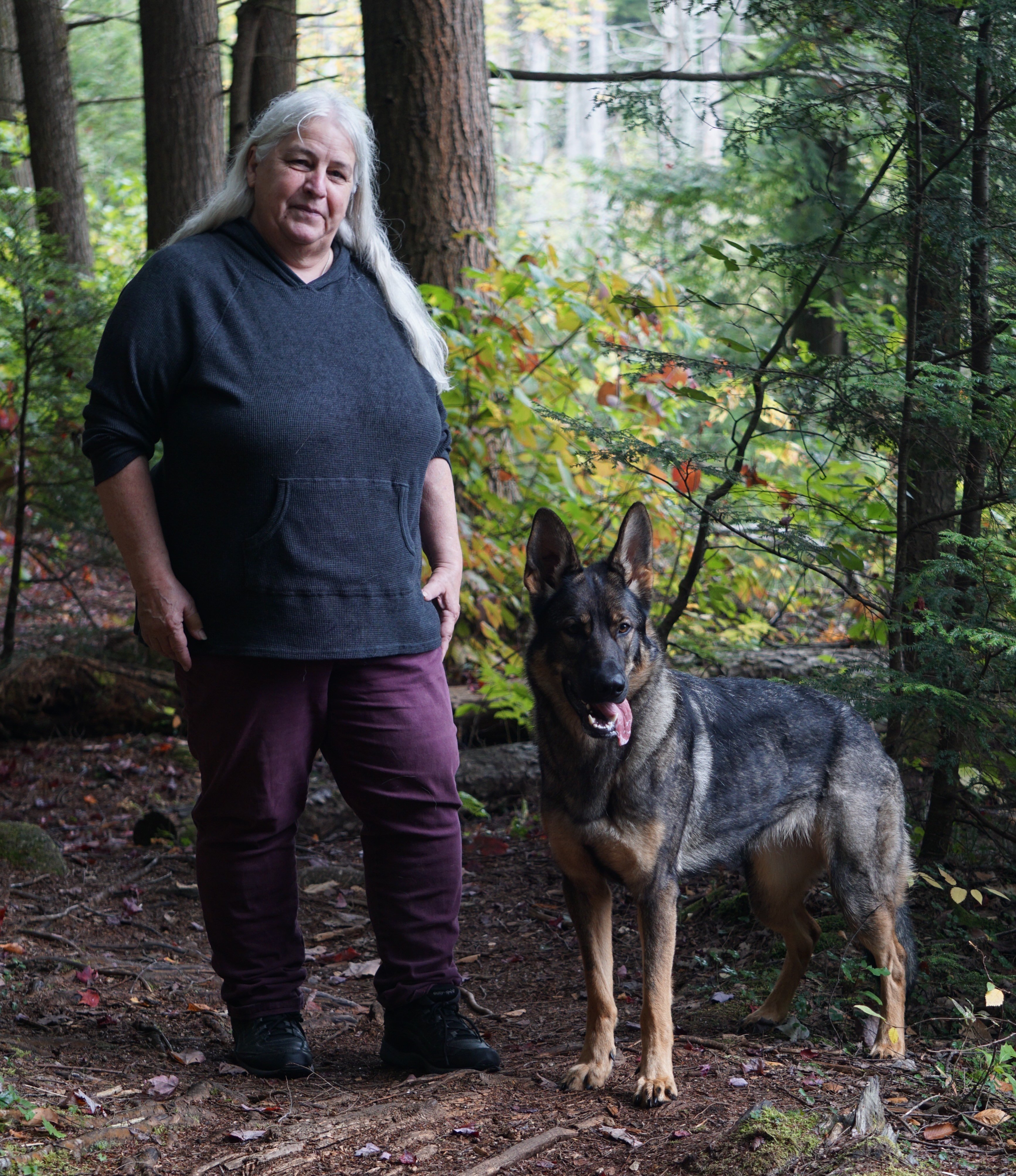
The late R.K. Anderson, DVM — one of the most respected voices in animal behavior — called Suzanne Clothier "one of the best observers of dogs that I have ever seen."
But Suzanne will be the first to tell you that she wasn't born that way. Her legendary observation skills are the result of decades of deliberate, systematic practice. Drawing from ethology, cognitive science, and more than forty years of hands-on experience with animals of all kinds, she has spent years distilling how she learned to see into something she can teach.
Really seeing the dog in front of you is critical to the training decisions you will make with and for that dog. If you work with shy, fearful or aggressive dogs, missing important information can create inhumane or dangerous situations. All dogs need your best observations at work for them.
This course is ideal for anyone who wants to add new ways to observe and understand dogs. Join us!
Starting April 12th we will release two sessions per week for six weeks (each about an hour+) plus practice work, plus a live Q&A session with Suzanne (live attendance is optional, they will be recorded for viewing at your convenience) plus a 7th week wrap-up Q& A session. The Q&A Sessions are tentatively scheduled for Tuesdays at 10:30 AM EST starting week April 21. You have access to the course for a full year.
Plan on spending 2-4 hours per week watching Suzanne's presentations, plus an hour or so with the Q&A sessions. Multiple observation practice sessions are done in short bursts of time throughout your day, ranging from 30 seconds to 5-10 minutes to complete.
Yes, CEUs are pending for IAABC, KPA and PPAB. We are sorry we cannot offer CEUs for CCPDT, they do not approve them.
Yes, this is one of the prerequisites, the other being Intro to CARAT.
No - Observation Skills is a stand alone courses. You do have to complete Observation Skills and Intro to CARAT if you are interested in pursuing CARAT Certification, but they can be done in any order. Observation Skills is open to anyone interested in learning how to really SEE THE DOG in new ways.